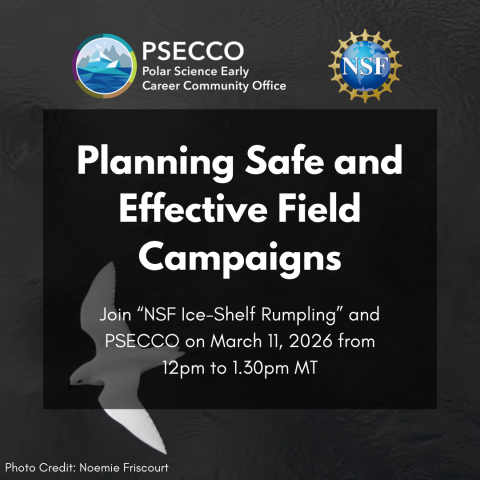
Planning Safe and Effective Field Campaigns
-
-
11
March 2026
Wednesday
12:00 pm - 1:30 pm
On Wednesday, March 11, 2026, the Polar Science Early Career Community Office (PSECCO) and the NSF Ice-Shelf Rumpling Project co-hosted ‘Planning Safe and Effective Field Campaigns’, a 1.5-hour panel discussion designed specifically for early‑career researchers preparing for fieldwork in the Arctic or Antarctic. This conversation brought together experienced field scientists to dig into what actually makes a field campaign run smoothly. Panelists discussed essential pre‑field training, how to build clear communication structures within your team, and strategies for responding when plans inevitably shift in extreme environments or unforeseen challenges arise.
A recording of the event can be accessed here.
About the Panelists
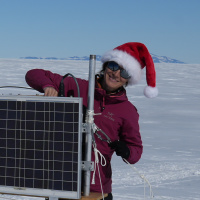
Alison Banwell holds dual appointments as a Research Scientist III in the Cooperative Institute for Research in Environmental Sciences (CIRES), University of Colorado Boulder, and as a Professor in the Centre for Polar Observation and Modelling (CPOM) at Northumbria University, UK. She is a glaciologist whose research focuses on monitoring and quantifying Antarctic and Greenland ice-sheet and ice-shelf melt, hydrology and dynamics using satellite remote-sensing and field observations. Ali is PI and field lead of the NSF Rumples Project, bringing particular expertise in GNSS, automatic weather stations, and time-lapse photography. This project marked her seventh Antarctic deployment (sixth as field lead), and she has also conducted glaciological fieldwork in Greenland, Svalbard, the Himalayas, and the European Alps.
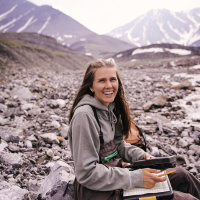
Amelia Grose is a postdoctoral researcher at McGill University in Montreal, Canada, studying the hydrology and biogeochemistry of Arctic rivers. She uses a combination of fieldwork and modeling to understand hydrologic flowpaths and the evolution of the active layer across the Arctic thaw season. She recently completed her PhD at Michigan State University, during which she spent over 13 months across five summers conducting fieldwork based at Toolik Field Station in Arctic Alaska. Her Arctic fieldwork experience includes collecting countless water samples and measurements via helicopter and hiking, trekking sensors and car batteries across the tundra for deployment in Arctic streams, and boating to deploy in-lake sensors.
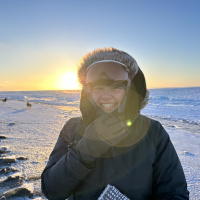
Kitrea Takata-Glushkoff is a geoscience graduate student at the University of Alaska Fairbanks Geophysical Institute, focused on co-producing knowledge of climate change with coastal Indigenous communities. Her current research centers Alaska Native Yupik knowledge, tracking Bering Sea ice change and its implications for food sovereignty. She regularly travels to Sivuqaq Yupik homelands (Gambell, St. Lawrence Island), working closely with hunters, observing daily sea ice and weather conditions, conducting interviews, and building community relationships. Her field experience also includes sea ice geophysics in Utqiaġvik and Kotzebue, glaciology in the Wrangell Mountains, and prior oceanographic and geologic research outside the Arctic. She has also co-led field-based education with youth through Girls on Ice and Sivuqaq sea ice workshops. Beyond research, she further connects with these communities and environments through cultural and site-specific dance.
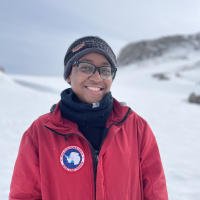
Maya Thomas (she/her) is a Ph.D. candidate and NSF Graduate Research Fellow at the Virginia Institute of Marine Science, William & Mary in Virginia, USA. For her marine science degree, she is studying how climate change affects zooplankton-mediated biogeochemical cycling in the West Antarctic Peninsula. In total, she has completed four field seasons in the Antarctic with over a year spent “on ice” as a member of the Palmer, Antarctica Long-term Ecological Research program. This included both ship- and station-based fieldwork on the ARSV Laurence M. Gould, R/V Nathaniel B. Palmer, and at Palmer Station, Antarctica. Prior to her Ph.D., Maya received her B.S. in marine biology from Nova Southeastern University in Florida.
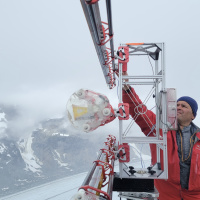
Ryan Cassotto is an Assistant Research Professor in the Climate Change Institute at the University of Maine and a Research Scientist in CIRES at the University of Colorado. A glaciologist by training, he uses remote sensing observations to study near-surface geophysical changes due to glacial flow, permafrost degradation, plate tectonics, wildfires, landslide motion and slope instabilities. He is a Co-PI on the NSF Rumples Project where he led the TRI measurement campaign, assisting with the GPR and ApRES measurements, and compiling satellite-based data to complement our ground measurements in McMurdo. The Rumples project was Ryan’s first trip to Antarctica; however, he has conducted several field campaigns in Greenland and Alaska over the last 16 years.
Relevant links shared during the event can be found below.
- ADVANCEing FieldSafety Course: https://fieldsafe.colorado.edu/course-overview/massive-open-online-course
- Safe and Harassment-free Fieldwork (SAHF) Plans: https://www.nsf.gov/funding/safe-fieldwork
- Wilderness First Aid and Expedition Training for Polar Fieldwork: https://expedition-services.de/en/kurse/
FAQ for virtual PSECCO-hosted events
All participants are expected to follow PSECCO’s community guidelines throughout the entirety of the event.
We highly encourage participants to have a working camera that is on during events, as it allows for better engagement. However, a camera is not a requirement to attend PSECCO events unless otherwise stated in the event description.
- Many of the events that we host are recorded. All recorded events are made available after the event on the Center for Education, Engagement and Evaluation (CEEE)’s YouTube channel in a PSECCO playlist to be viewed, within approximately one week of the event. All relevant links/resources are also made available after the event.
- Some of the events that we host heavily rely on real-time engagement or are discussion-based. These events are often not recorded. People will benefit most from these events if they attend them in their entirety.
- If you arrive late at an event, tech support will still be able to let you in up to 15-minutes into the event. After that time, no new attendees will be admitted, as we design our events to build upon the content foundation that is built at the start.
If you know that you can’t attend the event anymore, please cancel your registration by emailing psecco@colorado.edu no later than 48 hours before the event. This enables those who may be waitlisted to attend the event and also helps the PSECCO team accurately plan for the event.
- Upon registering for an event, you will receive a confirmation email from Constant Contact with a meeting link.
- We send pre-event reminder emails 2 weeks, 1 week, and 1 day prior to the event. The meeting link is hyperlinked in each of these reminder emails.
- If you are unable to access the meeting link through these methods, please email psecco@colorado.edu no later than 24 hours before the event.